Bumthang
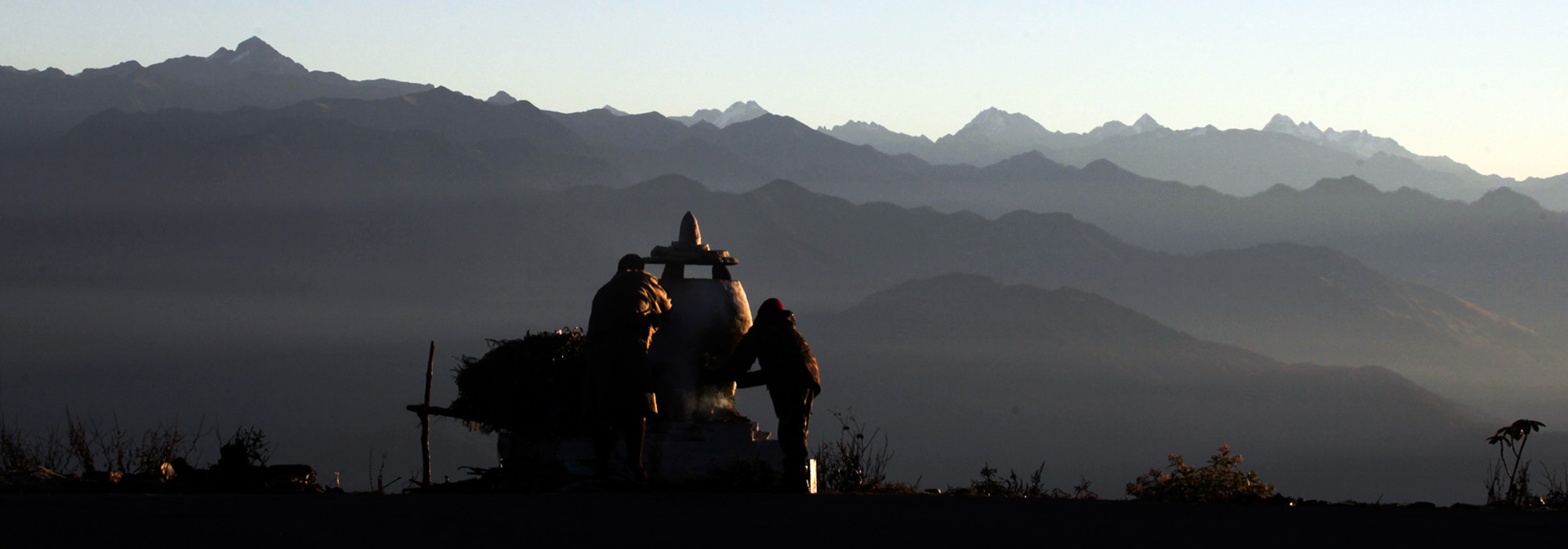
Bumthang is one of the 20 dzongkhag (districts) comprising Bhutan. It is the most historic dzongkhag if the number of ancient temples and sacred sites is counted. Bumthang consists of the four mountain valleys of Ura, Chumey, Tang and Choekhor (also known as Bumthang valley), although occasionally the entire district is referred to as Bumthang valley.
Bumthang Dzongkhag has four Gewogs, namely Chhoekor, Chumey, Tang and Ura located in four glacier valleys. Despite altitude constraints (2004-6000 m above the sea level), Bumthang is one of the prosperous Dzongkhags in the Country.
Favorable terrain conditions coupled with high motor road access has brought manifold changes in the socio-economic uplift of the Bumthang people. The Dzongkhag has a total road network of 285.334 km inclusive of 122 km of National Highway.
Income from potatoes, livestock farms and more recently tourist lodges are gradually changing the economic landscape of the people in the Dzongkhag. Sale of Cordecyps, Masutake and medicinal plants have further enhanced purchasing power of people of upper Chhoekor and Ura gewogs.
With total of 19 schools and 4,194 students, Bumthang has the highest educational coverage. Over 90 percent of households have access to safe drinking water. Dzongkhag has 95 percent health coverage. Over 90 percent of households have proper sanitation facilities. Most of the sub-urban households have access to direct telephone facilities with 1453 households having telephone connections.
“Bumthang” directly translates as “beautiful field”. “Thang” means field or flat place, and “Bum” is said be an appreviation of either “bumpa” (a vessel for holy water, thus describing the shape and nature of the valley), or “bum” (”girl”, indicating this is the valley of beautiful girls).
Cultural and historic sites in the dzongkhag include:
* Membar Tsho (Burning Lake), where sacred scriptures hidden by Guru Rimpoche in the 8th century where later recovered by Pema Lingpa in the 15th century
Kurje Monastery : Kurje Lhakhang: Located further along the valley, Kurje Lhakhang comprises three temples. The one on the right was built in 1652 against the rock face where Guru Padmasambhava meditated in the 8th century. The middle temple is built on the site of a cave containing a rock with the imprint of the Guru’s body, and is therefore considered to be the most holy. The temple on the left was built in the 1990s by H.M. Ashi Kesang, the Queen Mother. These three temples are surrounded by a 108 Chorten wall.

Jambay Lhakhang, one of the two most ancient temples of Bhutan, built in the 7th century by the Tibetan king, Songtsen Gampo. It is one of 108 monasteries which he built to subdue evil spirits in the Himalayan region. Its present architectural appearance dates from the early 20th century.
Tamshing Lhakhang, the most important Nyingmapa temple in the country. Located across the river from Kurje Lhakhang, this temple was founded in 1501 by Terton Pema Lingpa, a re-incarnation of Guru Padmasambhava. There are very old religious paintings around the inner walls of the temple, which was restored at the end of the 19th century.
Jakar Dzong, Constructed in 1549 by the great grandfather of the first Shabdrung, the Dzong was initially built as a monastery. It was upgraded in 1646, after the Shabdrung had firmly established his power. Jakar Dzong is now used as the administrative center for Bumthang valley, and also houses the regional monk body.
Bumthang farms yield buckwheat, dairy products, honey, and apples among other products.
The language spoken in the Bumthang district is known as Bumthangkha. It is a Tibeto-Burman language closely related to Dzongkha, the national language of Bhutan. Bumthangkha is partially comprehensible to speakers of Dzongkha, which originated in valleys to the west of Bumthang. Each of the four valleys of Bumthang has its own dialect, and the remnants of the Kheng kingdom to the south in Zhemgang speak Khengkha which may be classified as a dialect of Bumthangka.