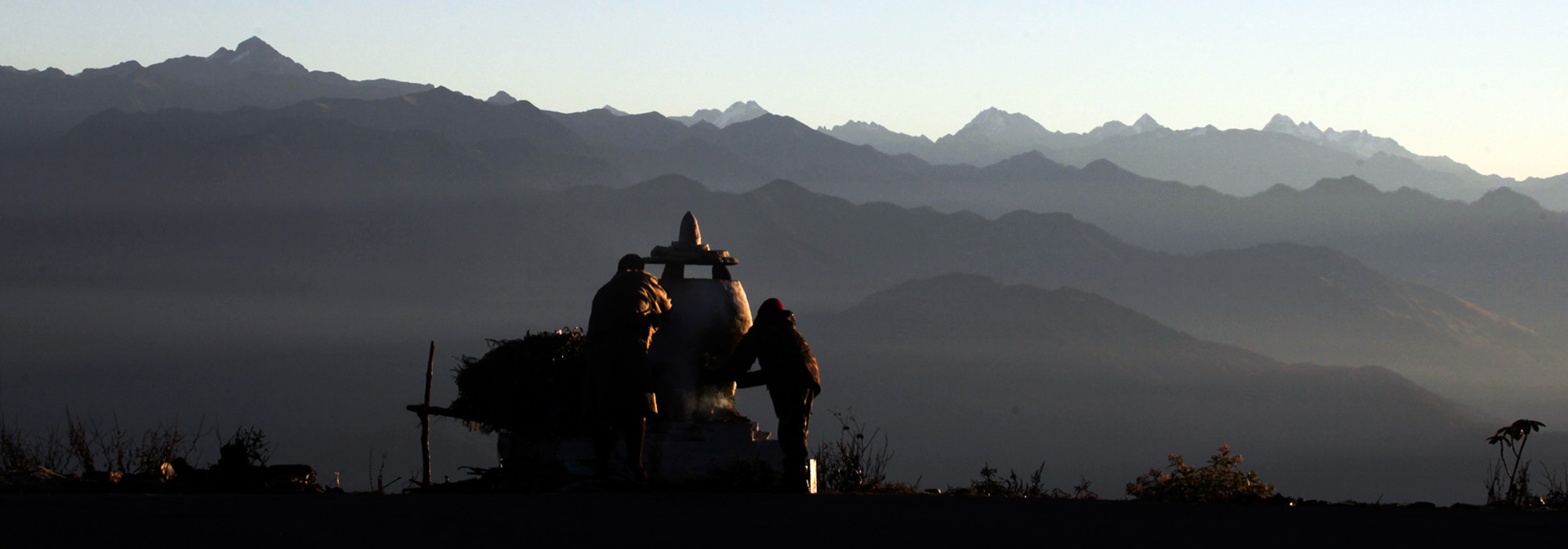
Trongsa

Bhutan Trongsa DistrictsTrongsa is one of the districts of Bhutan. It is the most central district of Bhutan and the geographic centre of Bhutan is located within it.

Yongzin Ngagi Wangchuk who was guided, in a vision, by the guardian deity, Palden Lhamo, to go to a place in the central Bhutan which resembled a bow and which was in food grains (mang-dru) where the name Mangdue has its origin, arrived in Trongsa in 1541 where he took residence in the village of Yueli. One night while Yongzin Ngagi Wangchuk was meditating his attention was drawn by a flicker of light, resembling that of butter lamp burning in the open air, at the spot where the present day Goenkhang of the Trongsa Dzong is located. In 1543, he established a small Tshamkhang (meditation quarter) in the sacred spot and meditated there. He soon attracted a number of disciples who built their own meditation unit around the main Tshamkhang. The cluster of newly built meditation quarters appeared to the people of Yueli above like a new village and hence they called it “Trongsa” meaning “new village.”

Trongsa Dzongkhag is located in the heart of the country. It covers an area of about 1807 km², with elevation ranging from 800 meters to 4,800 meters above sea level with a total population of about 13,428. It shares boundaries with Bumthang Dzongkhag to the northeast, Wangdiphodrang Dzongkhag to the west and Zhemgang Dzongkhag to the south.

Despite formidable rugged terrain in most part of the Dzongkhag, the blacked topped East-West highway and the Trongsa-Gelephu highway passes through the Dzongkhag connecting almost all the gewogs, which serves as the main economic artery.
Though the East-West and Trongsa-Gelephu highway passes through the Dzongkhag, most settlements are still remote due to lack of feeder roads. This combined with the rugged terrain makes delivery of services difficult and costly. Still, every Gewog in the Dzongkhag have a BHU, RNR centers and a School each providing basic services, where it is further supplemented by Community Primary Schools and Out Reach Clinic.

Trongsa Dzongkhag consists of five geogs namely, i. Drakteng covering 84.8 km², ii. Korphu iii. Nubi with 554.4 km², iv. Langthil with 508.4 km² and v. Tangsibji with 371.6 km², where Nubi is the most densely populated geog of the Dzongkhag. Agriculture farming is the main source of income for majority of the population.
Farmers grow almost all kinds of crops but in some areas potatoes are the main source of cash income.

Trongsa is one of the, historically and ecologically extremely important and fragile Dzongkhag in the Kingdom. Trongsa Dzong was headquarter of eastern region and have been the seat of Trongsa Penlop. Even today every Crown Prince of Bhutan have to be formally investiture as a Trongsa Penlop before becoming the hereditary King of Bhutan.

There are sacred monuments like tapering rock in Nubji lakhang, Kubra,Ugen Drak and Phumzur lhakhang, which are all believed that Guru Padmasambhava has visited and meditated in this sacred sites on his way back from Bumthang to India in 8th centuries. Very few people excluding the local people visit these sacred sites because of inadequate road facilities.
The other sacred spots in Trongsa are Ta-Dzong and Trongsa Dzong that lulls immense attraction of tourist.

Jigme Singye Wangchuck National Park that covers an area of 1723 km² is a home for many globally endangered rare floras and fauna of the country, and it’s a habitual place for one of the most globally endangered spices Golden Langur. The Park was gazetted in 2000 in order to protect large area of virtually untouched ecosystem ranging from mixed conifer in the north to chirepine / broadleaf forest in the south. The Monpa resides on the lower parts of the Jigme Singye Wangchuck National Park.

The Mangduechhu River flows through the heart of the Dzongkhag dividing the Dzongkhag almost into two half’s. This Dzongkhag enjoys a mixed climate, that is, warm humid and warm temperate with soil type sandy loam and clayey loam. The topography is rugged with deep gorges to the north and steep slope in the south.

The center is at Trongsa Dzong.

Geography

Trongsa is bordered by Wangdue Phodrang dzongkhag to the west and Bumthang dzonghag to the east. To the south it borders Tsirang, Sarpang, and Zhemgang dzongkhag.

Trongsa Dzong Trongsa Choekor Rabtentse Dzong : Built in 1648, it was the seat of power over central and eastern Bhutan. Both the first and second kings of Bhutan ruled the country from this ancient seat. All four kings were invested as Trongsa Penlop (“governor”) prior to ascending the throne, and the present Crown Prince now holds the post. The Dzong is a massive structure with many levels, sloping down the contours of the ridge on which it is built. Because of the Dzong’s highly strategic position, on the only connecting route between east and west, the Trongsa Penlop was able to control effectively the whole of the central and eastern regions of the country from here.

Ta Dzong: This watchtower, which once guarded Trongsa Dzong from internal rebellion, stands on a steep slope above the town. Climb up the path to visit Ta Dzong which now houses a shrine dedicated to the epic hero, King Gesar of Ling. A visit to this former watchtower provides visitors with an insight into the significance of Trongsa in Bhutan’s history.

Chendibji Chorten

Chendibji Chorten (Nepalese Style Stupa)

En route to Trongsa is Chendebji Chorten, patterned on Katmandu’s Swayambhunath Stupa, with eyes painted at the four cardinal points. It was built in the 18th century by Lama Shida from Tibet, to cover the remains of an evil spirit that was subdued at this spot.

WP SlimStat